Severins City Gate


A gauntlet run – everyone knows what the word means. Fortunately, today in Europe, no one has to experience it anymore. In the Middle Ages, it was different – and in Cologne, the Severinstor played a role in this: Here, offenders who were not facing the death penalty were driven down Severinstraße to Severinstor with a wooden coat, the "Huick," accompanied by insults, blows, or flogging with the whip. Their ordeal ended only when they passed the Schmitz bakery at Severinstraße 5, to then leave the city through Severinstor. This practice led to the Cologne saying "Du bes noch nit lans Schmitz-Backes," meaning "you're not out of danger yet."
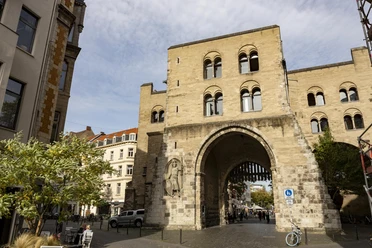
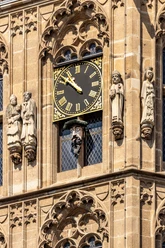
Of course, the long history of the Severins City Gate points to much more than just this narrative. As one of four surviving of the former twelve gate castles of Cologne in the eight-kilometer-long city wall, it secured Cologne to the south towards Bonn and is today considered an extraordinary example of medieval fortification architecture and a landmark of the Severinsviertel.
During the Middle Ages, Severinstor served as one of Cologne's representative gates, to welcome nobles and kings, princes, and princesses, such as in 1235 Isabella of England, wife of the Hohenstaufen Emperor Frederick II. In 1327, Emperor Louis IV of Bavaria and his wife Margaret of Holland announced an eight-day tournament here.
Today, the traditional Carnival Rose Monday parade in Cologne starts with a ride through Severinstor – and the Carnival club "KG Ponyhof e. V." uses the gate castle as its clubhouse. Cologne legends also play out at Severinstor – like that of Jan and Griet: Once rejected by the maid Griet, Jan rode back through Severinstor to Cologne after many years returning from war, and his triumphant appearance made Griet regret her former decision. You can learn more about this charming tale through the Jan von Werth monument at Alter Markt in Cologne's old town.
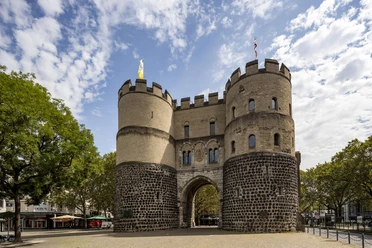
Only four of these gates have survived to this day – alongside Severins City Gate, the Hahnen City Gate, the identical Eigelstein City Gate at Eigelstein near Ebertplatz, and the Ulrepforte at Sachsenring in the Old Town South. The other eight of the former twelve gate castles disappeared with the demolition of large parts of the city fortifications in the 19th century.
The central location of these gate castles in modern Cologne makes them exciting starting points for your exploration tours. Set out from here and explore Cologne's medieval heritage while simultaneously experiencing the vibrant life of the present.
Of course, the long history of the Severins City Gate points to much more than just this narrative. As one of four surviving of the former twelve gate castles of Cologne in the eight-kilometer-long city wall, it secured Cologne to the south towards Bonn and is today considered an extraordinary example of medieval fortification architecture and a landmark of the Severinsviertel.
History of the Gate Castle
The gate castle was named after the parish of St. Severinus, which itself traces back to Saint Severin, Bishop of Cologne. It was built in the first half of the 13th century – with a hexagonal tower structure and a crenellated roof platform. The two-story flanking towers were added later, and the superimposed conical helmets in the 17th century, serving direct defense of the entrance.During the Middle Ages, Severinstor served as one of Cologne's representative gates, to welcome nobles and kings, princes, and princesses, such as in 1235 Isabella of England, wife of the Hohenstaufen Emperor Frederick II. In 1327, Emperor Louis IV of Bavaria and his wife Margaret of Holland announced an eight-day tournament here.
Interesting Facts: Severins City Gate Today
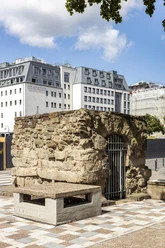
After 1881, Severins City Gate first housed a natural history and then a hygiene museum. During the Nazi era, the gate castle served as the headquarters of the Cologne Hitler Youth. From 1979, it became a community center. It was not until 2005 that construction work for the subway uncovered the foundations of the "Bollwerk" in front of the Severins City Gate, which was additionally built in 1474 to protect the gate because an attack by Duke Charles the Bold of Burgundy was expected. The protection was to withstand artillery fire. However, Cologne was not attacked and this "bastion" was demolished in the 19th century during urban renewal.Today, the traditional Carnival Rose Monday parade in Cologne starts with a ride through Severinstor – and the Carnival club "KG Ponyhof e. V." uses the gate castle as its clubhouse. Cologne legends also play out at Severinstor – like that of Jan and Griet: Once rejected by the maid Griet, Jan rode back through Severinstor to Cologne after many years returning from war, and his triumphant appearance made Griet regret her former decision. You can learn more about this charming tale through the Jan von Werth monument at Alter Markt in Cologne's old town.
Twelve Gate Castles of Cologne, to Protect the City…
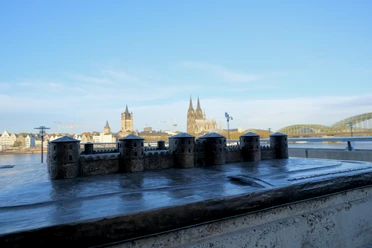
Even today, the four surviving gate castles give an impression of the former size of Cologne's city wall. The medieval city gates always served multiple purposes at the same time: they were protection, threshold, and representation. Moreover, they shaped the city itself as a significant metropolis in Europe and controlled the access of traders, travelers, and pilgrims – as well as ideas, goods, and cultures.Only four of these gates have survived to this day – alongside Severins City Gate, the Hahnen City Gate, the identical Eigelstein City Gate at Eigelstein near Ebertplatz, and the Ulrepforte at Sachsenring in the Old Town South. The other eight of the former twelve gate castles disappeared with the demolition of large parts of the city fortifications in the 19th century.
The central location of these gate castles in modern Cologne makes them exciting starting points for your exploration tours. Set out from here and explore Cologne's medieval heritage while simultaneously experiencing the vibrant life of the present.
Good to know
Eligibility
for Groups
for families
for individual guests
Payment methods
- no entrance possible
Directions & Parking facilities
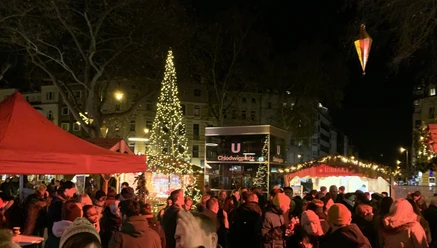
- The walk from the stop Chlodwigplatz (Tram: 15, 16, 17) to the Severins City Gate is about 1 minute.
General information
Bus stop available