Fortuna Köln - Season 2026/27


You see the stadium before you find it: four freestanding floodlight masts rise above the rooftops of Zollstock, the residential district in Cologne’s south. As kick-off approaches, more and more red-and-white scarves appear in the streets. Then, on Vorgebirgstraße, comes the ticket booth — and you can usually still get tickets here on match day. Behind it lies the Jean Löring Sports Park, named after the president who shaped Fortuna for decades. And at its heart: the Südstadion, the club’s home since 1978.
One covered stand, the rest under open skies
The Südstadion is one of those stadiums that barely exist anymore. Only the main stand, with its seats, is covered; opposite it and around the corners, you stand on open terraces, with a running track separating the stands from the pitch. In total, the stadium holds more than 10,000 people — though there is usually enough space for you to choose your own spot.
Fortuna was founded in 1948, just eight days after 1. FC Köln, emerging from three clubs in Cologne’s south. What began as a local neighbourhood has long since become a world of its own — with its own stadium, its own songs, and its own pride.
Ninety minutes in which you hear everything
The first thing you notice here is the acoustics. No upper tier, no enclosed bowl — instead, you hear the players shouting on the pitch, the instructions from the dugout, and the comments from the standing terraces in between. At the Südstadion, the action unfolds right in front of you. You are practically in the middle of it.
Anyone standing here for the first time ends up in conversation, whether they mean to or not — about the line-up, the referee, or the bratwurst in their hand. Fortuna is a club where emotions rarely settle somewhere in the middle: plenty has been celebrated here, and plenty has had to be processed — often in the very same season.
After the final whistle: head to the clubhouse
This place has seen its share of big football nights. Fortuna spent 26 consecutive seasons in the 2. Bundesliga — a record. In 1983, as a second-division side, they reached the DFB Cup final after knocking Borussia Dortmund out 5–0 in the semi-final. The final against 1. FC Köln — still the only DFB Cup final ever contested by two clubs from the same city — was narrowly lost in Müngersdorf in front of 61,000 spectators.
Tip: Don’t plan anything else after the final whistle. Fans gather at the clubhouse right next to the grounds even before the match — and afterwards, players and coaches join them to talk through the afternoon together. You rarely get closer to a professional club than this.
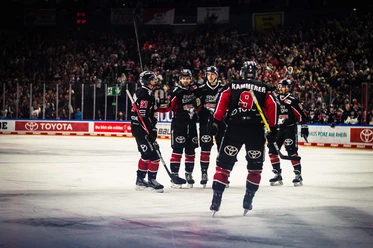
Are you a fan of 1. FC Köln, Viktoria Köln, or the Kölner Haie? Take a look at when these clubs are playing at home for a true Cologne experience.
Dates
Good to know
General information
Open Air
Eligibility
Target Group Teenager
Target Group Adult
Target Group Family
Target Group the Elderly
for familys
for individual guests