Hänneschen Theater


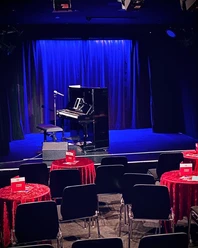
In the Hänneschen Theater at Eisenmarkt, a piece of Cologne's heart lives on – as written at the Hänneschen and as it is felt. Revered by the people of Cologne, the Hänneschen brings the city of Cologne, its way of life, and the mentality of its residents to the puppet stage – explicitly for children and adults. As a fairy tale, as social satire, with local color and humorous stories full of Cologne feeling. The setting is always Knollendorf, a fictional mirror of Cologne with a characteristic mix of milieus, providing rugged entertainment through frictions, challenges, and reconciliations.
A cultural-historical fact: The Hänneschen Theater is the oldest permanent puppet stage in the German-speaking world and one of the largest puppet theaters in Western Europe.
The Hänneschen quickly became an institution closely linked to Cologne's carnival. After Winters' death in 1862, his family continued the theater until 1919, when the last family member died. The Hänneschen, however, had to remain in Cologne, a commission suggested: In 1926, the theater was newly founded as the “Puppet Shows of the City of Cologne” under municipal ownership. In 1938, the Hänneschen moved to its home at Eisenmarkt – accompanied by a large parade with thousands of spectators, according to theater lore – before war and the Nazi era opened a difficult chapter: burdensome content, destruction, and the loss of many historical puppets. A new beginning succeeded from 1948 with new characters, a new troupe, and the return to Eisenmarkt in Cologne’s Old Town, where you can still find the entrance today.
Incidentally, you can find a memorial of the founding father Johann Christoph Winters at the Melaten Cemetery – an artful stele with a bust of Winters and key figures from his puppet theater.
A cultural-historical fact: The Hänneschen Theater is the oldest permanent puppet stage in the German-speaking world and one of the largest puppet theaters in Western Europe.
Every season: Six premieres – spoken and sung live in Kölsch
The Hänneschen is handmade – in many ways: all plays are written, spoken, sung, and performed in Kölsch. The music is also handmade. Every season, you have the opportunity to attend six different premieres. Tip: Tickets always sell out quickly, so plan ahead.Characters of Hänneschen: Types and characters with contrasting human traits
The rod puppet show has grown in the Rhineland as a dialect and milieu theater; hence, the characters are not fairy tale figures but “people next door”: exaggerated, contrasting types. They comment on everyday life and inspire, with much humor, to accept and endure human diversity. You can expect a delightful spectacle where you will likely recognize some types from your own life, even if they are slightly distorted through Kölsch language and mentality.Core characters: Hänneschen, Bärbelchen, Tünnes, and Schäl
In the fictional community “Knollendorf” – probably somewhere in Cologne – live the Kölsch whirlwind Hänneschen and his wise friend Bärbelsche, the Cologne cult figures Tünnes, Schäl – also immortalized in the Tünnes-und-Schäl monument – and many supporting characters like Schnäuzerkowski, Köbeschen, or Zänkmanns Kätt. As caricatured types, they all exhibit clear traits that the Hänneschen Theater categorizes as “backbone,” “weakness,” “task,” and “to the point.” You can find the character descriptions on the Hänneschen Theater’s website if you want to get an idea before your visit.Long history of the Hänneschen Theater: succinctly condensed
For pragmatic reasons – namely to survive in the first place – tailor's assistant Johann Christoph Winters founded a theater in 1802, which should shape and reflect Cologne to this day: the Hänneschen. From the initial “nativity play for small children,” a traditional rod puppet stage emerged: Puppeteers direct the characters from below and move the head and hands with rods.The Hänneschen quickly became an institution closely linked to Cologne's carnival. After Winters' death in 1862, his family continued the theater until 1919, when the last family member died. The Hänneschen, however, had to remain in Cologne, a commission suggested: In 1926, the theater was newly founded as the “Puppet Shows of the City of Cologne” under municipal ownership. In 1938, the Hänneschen moved to its home at Eisenmarkt – accompanied by a large parade with thousands of spectators, according to theater lore – before war and the Nazi era opened a difficult chapter: burdensome content, destruction, and the loss of many historical puppets. A new beginning succeeded from 1948 with new characters, a new troupe, and the return to Eisenmarkt in Cologne’s Old Town, where you can still find the entrance today.
Incidentally, you can find a memorial of the founding father Johann Christoph Winters at the Melaten Cemetery – an artful stele with a bust of Winters and key figures from his puppet theater.
Good to know
Eligibility
Bad Weather Offer
for families
for individual guests
Price info
- Prices vary depending on the event.
Directions & Parking facilities
- You can reach the Hänneschen Theater via the Heumarkt stop. It is about 250 meters on foot.