Roman Fountain

How did it all begin when Romulus killed his brother and founded Rome? In the much-acclaimed Italian feature film "The First King - Romulus & Remus" from 2019, the story of Romulus and Remus culminates in the deadly conflict between the brothers, leading to the founding of Rome. Historically, Titus Livius and Plutarch date this to the 21st of April, 753 B.C. In the film, the brothers are captured in the region of Latium after a flood and sold into slavery; a rebellion, a liberation, and the formation of a small community ensue, leading to the deadly showdown. The story of Romulus and Remus was the focal point of attention, not just today but even in antiquity, in the explanation of the name for the great "Eternal City."
What is absent from this cinematic work, however, is the she-wolf from the famous myth—the one that sits atop the ancient Roman fountain in Colonia Claudia Ara Agrippinensium, CCAA, or Cologne, the same that is said to have suckled the brothers, significantly leading to the founding of Rome.
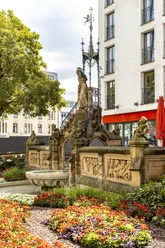
Contrary to perhaps spontaneous intuition, the famous Roman Fountain in Cologne does not date back to Roman times but to 1915, marking the artistic engagement with Cologne's past as one of the most significant cities of the Roman Empire. Situated directly next to the historic Arsenal with the winged car on the roof, the former location of the Cologne City Museum, the large Roman Fountain by Franz Brantzky invites you to linger, with a view of the Cathedral included.
Incidentally, fountains ensured Cologne’s water supply until the 19th century until their primary supply function transitioned to decorative structures—with the first municipal waterworks established in 1872.
Cologne offers many other monuments and fountains within walking distance for you to visit, such as the Heinzelmännchenbrunnen—a symbol of the famous story about the Heinzelmännchen of Cologne—or the Ostermann Fountain, which commemorates the singer Willi Ostermann and his songs about the Cologne Carnival. Or the Dionysos Fountain, which recalls the Roman Bacchanalia.
What is absent from this cinematic work, however, is the she-wolf from the famous myth—the one that sits atop the ancient Roman fountain in Colonia Claudia Ara Agrippinensium, CCAA, or Cologne, the same that is said to have suckled the brothers, significantly leading to the founding of Rome.
Monument to the Founding Myth: Column with She-Wolf
Fountains supplied Roman Cologne with water as early as the 1st century AD. These Roman engineering feats can be admired in “Roman Cologne” today as remnants of the baths at Neumarkt, the Eifel Aqueduct, or by observing the parts of the sewer system that can be visited.Contrary to perhaps spontaneous intuition, the famous Roman Fountain in Cologne does not date back to Roman times but to 1915, marking the artistic engagement with Cologne's past as one of the most significant cities of the Roman Empire. Situated directly next to the historic Arsenal with the winged car on the roof, the former location of the Cologne City Museum, the large Roman Fountain by Franz Brantzky invites you to linger, with a view of the Cathedral included.
Incidentally, fountains ensured Cologne’s water supply until the 19th century until their primary supply function transitioned to decorative structures—with the first municipal waterworks established in 1872.
On Architecture
The wall of the large Roman Fountain connects two streets at different levels. At its center stands a semicircular wall, flanked on either side by additional walls. The double column with the figure of the suckling she-wolf is placed slightly to the left of the central wall at the edge of the street. Six relief panels on the central wall of the fountain depict motifs from Roman life. The left wall of the fountain displays figures from the Roman imperial dynasties over the centuries. A broad sheet of water cascades beneath the portraits into the collection basin.On History
Built from 1910 to 1915 by Franz Brantzky, the Roman Fountain also suffered damage during World War II and had to be reconstructed in 1955 in an altered form based on a design by Karl Band.Cologne offers many other monuments and fountains within walking distance for you to visit, such as the Heinzelmännchenbrunnen—a symbol of the famous story about the Heinzelmännchen of Cologne—or the Ostermann Fountain, which commemorates the singer Willi Ostermann and his songs about the Cologne Carnival. Or the Dionysos Fountain, which recalls the Roman Bacchanalia.
Good to know
Eligibility
for Groups
for Class
for families
for individual guests
Suitable for Pushchair
Payment methods
- Entrance Free
Directions & Parking facilities
- The walk from the stop Appellhofplatz (tram lines: 3, 4, 5, 16 and 18) to the Roman Fountain takes about 1 minute.