Wallraf-Richartz-Museum & Fondation Corboud


For more than 500 years, the blue of the Virgin Mary's robe has radiated with almost unchanged brilliance from the small-format painting measuring 51 x 40 centimetres and imagines truly heavenly spheres, pragmatically conjured up from crushed lapis lazuli, which was as expensive as gold in the Middle Ages and only reached Cologne on adventurous, long journeys from Afghanistan. Stefan Lochner's painting "Mother of God in the Rose Arbour" is one of the most famous paintings of the Middle Ages due to its mastery and symbolism and hangs in the Wallraf-Richartz-Museum - as do important paintings by Dürer, Rubens and Rembrandt, van Gogh, Monet, Manet, Renoir and Cézanne. This makes the Wallraf-Richartz-Museum of international standing.
The collection of the Wallraf-Richartz-Museum is extensive and spans epochs from the Middle Ages to modern times - over 700 years of art history on 3 floors. Special exhibitions, guided tours and events offer you plenty of variety if you come to Cologne and the Wallraf more often.
In 1968, Peter and Irene Ludwig's collection of modern art was added to the existing collection - and a joint new museum building for the two large collections was erected: the building of today's Museum Ludwig.
The collection of the Wallraf-Richartz-Museum is extensive and spans epochs from the Middle Ages to modern times - over 700 years of art history on 3 floors. Special exhibitions, guided tours and events offer you plenty of variety if you come to Cologne and the Wallraf more often.
Floor 1: Middle Ages
The medieval collection, with around 140 works spread over 13 rooms, is one of the most important of its kind in the world and includes important works from the Cologne School of Painting. In addition to the "Cologne Mona Lisa", Lochner's panel painting "Our Lady in the Rose Arbour" from 1440, you will have the opportunity to view Albrecht Dürer's Piper and Drummer or the Altarpiece of the Cross by the Master of the Bartholomew Altarpiece. The presentation of the works is designed in such a way that you can build a bridge from our everyday world to medieval art during your visit.Floor 2: Baroque
Each floor of this oldest museum in Cologne has its own highlights and offers you an exciting insight into the respective period. On floor 2, you will encounter masters such as Peter Paul Rubens with Juno and Argus and Rembrandt van Rijn with an enigmatic self-portrait as well as Murillo, Ribera, David Tenier and Francois Boucher with a few of their works. In addition to monumental paintings, still lifes and landscape paintings, small, fine cabinet paintings also invite you to take a closer look.Floor 3: 19th century
Are you a fan of Impressionism and the beginnings of Modernism and would like to see works by Monet and Manet, Renoir, Pissarro, Gauguin, Signac, Cézanne Ensor, Munch or van Gogh in the original? Climb up to the 3rd floor of the Wallraf-Richartz Museum. Thanks to a "perpetual loan" from the Corboud couple in 2001, you will find one of the most extensive collections of Impressionist art here. In gratitude, the museum has been known as the Fondation Corboud ever since.A brief journey through a long museum history
"As heir to my entire estate [...] I bequeath the city and municipality of Cologne, my father's city" read Ferdinand Franz Wallraf's will, thus establishing the history of the Wallraf-Richartz Museum. The art collector - and conservator of the Melaten Cemetery - Wallraf owned a large number of paintings, coins, works of art, drawings and altars, which went to the city of Cologne on Wallraf's death in 1824. However, it was not until 30 years later, thanks to a donation of 100,000 thalers from Johann Heinrich Richartz, that the first museum in the Rhineland could be built to exhibit Wallraf's collected art: on the grounds of the Minorite monastery in the north of Cologne's old town. The Wallraf-Richartz Museum opened in 1861, making it Cologne's oldest museum.Destruction and confiscation
In the years that followed, the museum's collection continued to grow through loans, donations and purchases. The museum suffered severe setbacks when the National Socialists confiscated numerous priceless works by Dix, Kokoschka, Munch, Picasso and Gauguin as "degenerate art". However, the rest of the collection was largely protected from the bombs of the Second World War, which completely destroyed the building, by being moved out of storage in good time.A new beginning - thanks to further donations
After the war, the lawyer and art collector Josef Haubrich donated his collection of Expressionist and Modernist works as a sign of a new beginning. In 1957, the new museum building was constructed, which today houses the Museum of Applied Arts .In 1968, Peter and Irene Ludwig's collection of modern art was added to the existing collection - and a joint new museum building for the two large collections was erected: the building of today's Museum Ludwig.
2001: The Wallraf finds its home
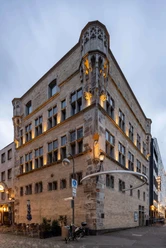
The collection continues to grow and the building becomes too small, so in 2001 the city commissions the construction of a separate building for the Wallraf-Richartz-Museum based on the plans of Cologne star architect Oswald Mathias Ungers: right in the historic center of Cologne, opposite the Fragrance Museum in the Farina House and in the vicinity of Stefan Lochner's former home. This brings us back full circle to our short journey through the museum's long history.Good to know
Foreign Language
- German, English
Eligibility
Bad Weather Offer
for Groups
for Class
Suitable for the Elderly
Suitable for Pushchair
for Children of the age of 6-10
for Children of the age of 10 upwards
Openings
- Starting August 3, 2026, the Wallraf-Richartz Museum will be closed for a comprehensive renovation expected to last approximately two years.Dayoff: Monday
Price info
Price adult: €10.00
Price child: Free entry
Price reduced: €7.00
Free admission for all Cologne residents on the first Thursday of every month.
Ticket prices may vary depending on the special exhibition.Directions & Parking facilities
- Public transport:
By train, S-Bahn (from the airport): "Hauptbahnhof" (5-10 minutes walk)
Underground: "Dom/Hauptbahnhof" (5-10 minutes walk),
Tram / Bus: "Heumarkt"
Parking garages:
Am Dom / An Farina / Groß St-Martin More information
- 1st Thursday of the month open 10-22 (except public holidays)
Other Furnishing/Equipment
Toilet